 EN
EN

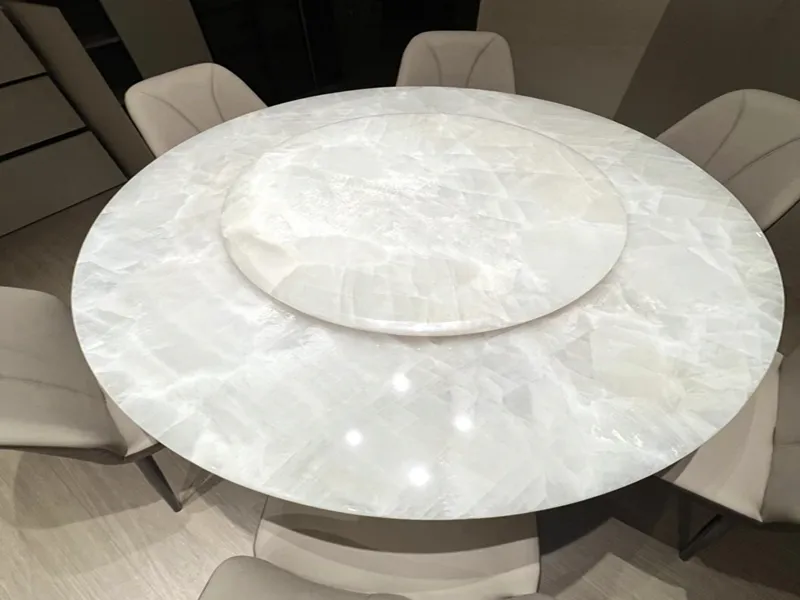
Travertine Table: Material Authenticity at the Heart of Minimalist Design
Neutral Tones and Organic Texture Reinforce Minimalist Principles
A travertine table anchors a room with an earthy palette of ivory, beige, and warm gray—hues that embody visual calm and align seamlessly with minimalist ideals. Rather than competing with surrounding elements, its muted spectrum enhances uncluttered spaces by adding depth without visual noise. The stone’s organic texture—subtle pits, gentle undulations, and faint veining—introduces quiet tactility, replacing decorative excess with sensory richness. Unlike hyper-polished composites, travertine’s natural grain invites touch and softens sleek architectural lines. In minimalist interiors, this balance of neutrality and texture becomes the focal point: authenticity, not adornment, defines refined simplicity.
Natural Variability as Intentional Simplicity—Not Flaw, but Focus
Travertine’s inherent irregularities—pores, fissures, and tonal shifts—are not flaws but signatures of material truth. Minimalism embraces this unvarnished character: each slab is inherently unique, functioning as a one-of-a-kind canvas. Designers often preserve these features by leaving voids raw or filling them with clear resin—a choice that honors the stone’s geological history rather than masking it. Over time, the surface develops a gentle patina, deepening its presence in a way that echoes wabi-sabi principles. In contrast to uniform manufactured surfaces, travertine’s natural variability serves as a quiet yet powerful focal point—affirming that simplicity lies not in sterility, but in intentional focus on what is real, enduring, and human-scaled.
Travertine Table Styling in Minimalist Interiors: Contrast Without Clutter
Low-Profile Silhouettes and Raw Edges Enhance Spatial Calm
A travertine table supports spatial calm when its form remains low and its edges unrefined. Its muted beige, ivory, or taupe tone reads as a quiet plane—not a statement piece—while a height of 28–30 inches preserves sightlines and amplifies perceived volume. Raw, chiseled edges or a honed, matte finish blur the boundary between object and space, allowing the table to emerge from the room rather than interrupt it. This restraint reflects the core minimalist tenet: every element must earn its place. Without ornate detailing or reflective surfaces, attention settles naturally on the stone’s grain and subtle pitting—offering a gentle counterpoint to stark white walls or exposed concrete floors. The result is monolithic presence without visual weight.
Case Study: A Leading Design Firm’s 2023 LA Residence Featuring a Centered Travertine Table
In a 2023 Los Angeles residence by a noted design studio, a large rectangular travertine table anchored an open-plan living area. Its warm, sandy hue harmonized with lime-wash walls and wide-plank oak flooring, while a 4-inch-thick, unpolished slab provided grounded tactility. A low plinth base—rather than legs—reinforced horizontal emphasis and spatial continuity. Linen-upholstered chairs in matching neutrals encouraged gathering without visual competition, and the only accent was a single hand-thrown ceramic vessel holding dried grasses. The travertine table became the room’s quiet center: proof that material integrity, natural variation, and thoughtful proportion can define minimalism without compromise.
Curating Cohesion: Pairing Travertine Table with Neutral, Textured Furnishings
The 3:1 Ratio Rule—Harmonizing Travertine with Matte Black, Linen, and Oak
Achieve cohesion by applying the 3:1 ratio: pair travertine with three soft, organic materials—such as linen upholstery, oak flooring or cabinetry, and the stone itself—and introduce one deliberate contrast, like matte black metal in a pendant light or chair frame. This balance prevents the space from feeling austere while preserving visual calm. Linen tempers travertine’s cool density, oak adds warmth and grain continuity, and matte black provides subtle definition—never dominance. The result is a layered, tactile composition where the table’s porous texture and pale tones remain central, and every adjacent material reinforces the room’s quiet, unforced elegance.
Rising Designer Demand for Travertine Table in Modern Luxury Projects
Travertine tables have evolved from functional furniture into sculptural anchors within modern luxury interiors. Top interior designers now prioritize natural stone for its ability to bridge raw materiality and refined minimalism—leveraging travertine’s organic warmth to humanize high-design spaces. At recent trade exhibitions—including the Xiamen Stone Fair—demand for stone furniture surged, reflecting a broader industry shift: from ornamentation toward material-led design. In luxury residences and high-end hospitality settings, the travertine table exemplifies a new standard of modernity—one defined not by complexity, but by integrity of substance, quiet confidence of form, and respect for natural variation.
FAQ Section
What makes travertine tables suited for minimalist interiors?
Travertine tables feature muted tones and organic textures that enhance minimalist spaces by adding depth without visual clutter. The material’s authenticity and tactility align with minimalist design principles.
How does travertine's natural variability impact the design?
Travertine's variability, such as pores and tonal shifts, showcases its natural character, creating unique pieces that focus on authenticity and material truth rather than uniform perfection.
What styling techniques can enhance a travertine table's presence in a room?
Low-profile silhouettes, raw edges, and harmonious material pairings like linen and oak can amplify spatial calm while highlighting the table’s natural grain and texture.
Why are travertine tables popular in luxury interiors?
Travertine tables bridge raw materiality and refined design, creating sculptural and functional furniture that exemplifies modern luxury. They humanize spaces while respecting material integrity.
What is the 3:1 ratio rule mentioned in the article?
The 3:1 ratio rule involves combining three soft, organic materials—like linen, oak, and travertine—with one contrasting element, such as matte black, to achieve cohesive yet visually balanced interiors.
Table of Contents
- Travertine Table: Material Authenticity at the Heart of Minimalist Design
- Travertine Table Styling in Minimalist Interiors: Contrast Without Clutter
- Curating Cohesion: Pairing Travertine Table with Neutral, Textured Furnishings
- Rising Designer Demand for Travertine Table in Modern Luxury Projects
-
FAQ Section
- What makes travertine tables suited for minimalist interiors?
- How does travertine's natural variability impact the design?
- What styling techniques can enhance a travertine table's presence in a room?
- Why are travertine tables popular in luxury interiors?
- What is the 3:1 ratio rule mentioned in the article?