 EN

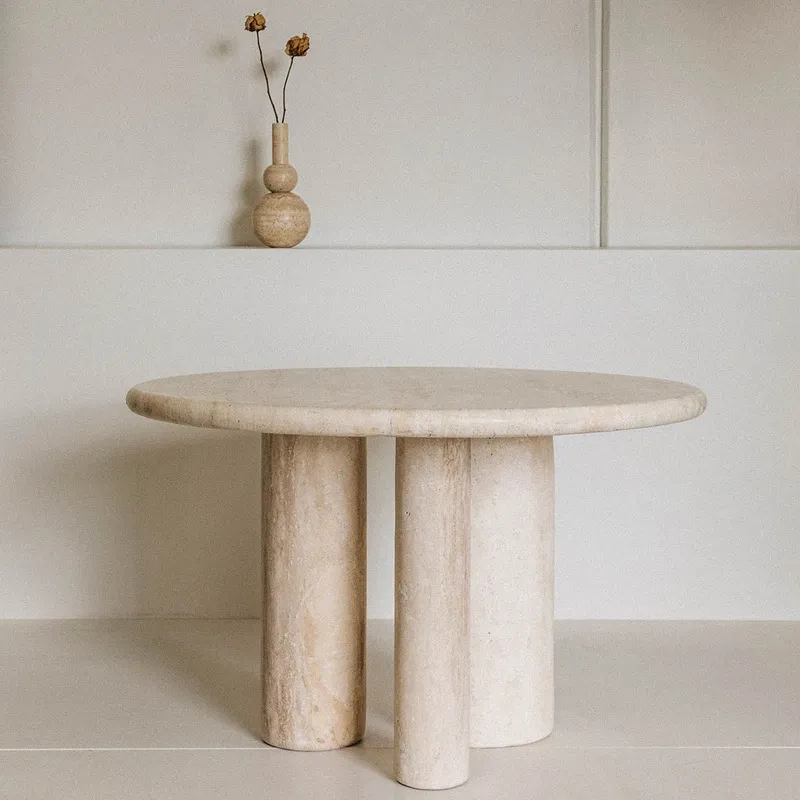
Structural Integrity: How Thickness Enhances Marble Table Strength and Crack Resistance
Compressive strength and flexural modulus scaling with slab thickness
A thicker marble table slab directly improves resistance to permanent deformation and sudden failure under heavy loads. Compressive strength—the material’s capacity to withstand squeezing forces—increases linearly with cross-sectional area. Doubling slab thickness effectively doubles the total load the stone can support before crushing, assuming consistent marble quality. Thus, a 3 cm thick slab safely holds more weight than a 2 cm panel.
Bending resistance improves even more dramatically: flexural modulus (stiffness) scales with the cube of thickness. A slab that is 50% thicker becomes roughly 3.4 times stiffer—significantly reducing sagging and tensile stress at the underside, where cracks typically initiate. Thin slabs bow under modest loads, concentrating stress at microscopic flaws along the bottom surface. Thicker sections distribute those stresses over a taller profile, keeping the lower face well within the stone’s elastic range. As a result, everyday use—leaning, placing heavy objects, or minor impacts—is far less likely to generate the critical stress needed to propagate a fracture.
Thermal expansion buffering and reduced crack propagation in thickened marble table slabs
Temperature fluctuations pose a silent threat to natural stone furniture. When a marble table absorbs heat unevenly, thin sections expand and contract rapidly, generating internal tension between the warm surface and cooler core. A thickened slab acts as a thermal buffer: its greater mass slows temperature change, allowing the entire cross-section time to equalize. This minimizes steep stress gradients—the primary driver of thermo-mechanical fatigue and micro-cracking in thinner panels.
Crack propagation follows the same principle. Once a fissure forms, the stress intensity at its tip determines whether it grows. In thin marble, even small loads concentrate enough energy at the crack front to extend it. In a thick slab, surrounding material shares the load more broadly, and crack-tip energy dissipates into a larger volume. This natural crack-arresting behavior explains why 3 cm or thicker marble tables often remain structurally sound and aesthetically intact for decades—while thinner alternatives develop visible fissures after just a few years of thermal cycling and daily stress.
Real-World Longevity: Load Performance and Edge Durability of Thickened Marble Table
Micro-fracture prevention under sustained load: Why 3 cm+ marble table slabs outperform thinner alternatives over 10+ years
Micro-fractures begin at microscopic surface imperfections and slowly propagate under sustained weight—from centerpieces, equipment, or even routine cleaning pressure. Increasing thickness from 2 cm to 3 cm or more reduces principal tensile stress at the lower surface by roughly 30–40%, per standard plate-bending mechanics. That stress reduction makes it far less likely for naturally occurring flaws to link up into visible hairline cracks. Over a decade of use, the extra mass also buffers thermal expansions and contractions that can pry open micro-fissures. And when edge impacts occur—as they inevitably do—the added mass absorbs kinetic energy that would otherwise chip a thinner rim. Together, these effects preserve structural integrity and surface aesthetics long after a 2 cm alternative shows cracking and edge spalling.
Hospitality case study: 92% retention rate for 3.2 cm marble table vs. 61% for 2 cm after 12 years
A 12-year audit by a multi-site hospitality group tracked 500 marble tables under heavy daily use. The 3.2 cm thick tables achieved a 92% retention rate—nearly all remained in service without structural replacement; only occasional re-sealing was required. In contrast, the 2 cm tables retained just 61% of their original units, with most failures traced to edge chipping, stress-cracks at leg attachment points, and full-thickness fractures. Subjected to identical banquet loads, staining risks, and maintenance routines, the thicker tables resisted edge spalling almost entirely. Operators confirmed the initial cost premium was more than offset by drastic reductions in replacement expenses and service interruptions—making the 3.2 cm specification the decisive factor in long-term durability for high-traffic venues demanding uninterrupted elegance.
Surface Protection & Maintenance: How Thickness Extends Sealer Efficacy on Marble Table
Deeper sealer impregnation and improved adhesion on thickened marble table substrates
A 3 cm or thicker marble slab offers a more substantial porous network, enabling penetrating sealers to infuse deeper below the immediate surface. This deeper resinous barrier slows liquid absorption from acidic spills and stains—buying critical cleanup time. Enhanced structural stiffness also reduces microscopic flexing during daily use, minimizing hairline fractures that compromise sealer adhesion. As a result, the protective layer remains intact longer, cutting reapplication frequency and preserving the stone’s natural luster well into its second decade.
Installation Stability and Vibration Resistance: The Hidden Role of Thickness in Marble Table Performance
A marble table’s long-term stability begins at installation. The mass and rigidity of a 3 cm+ slab reduce the risk of uneven settling and lippage—subtle height differences between panels that create an unprofessional, uneven surface. Increased weight compresses subfloor mortar or mounting structures more uniformly, eliminating micro-gaps common with thinner 2 cm slabs. This uniformity ensures a perfectly flat tabletop from day one and minimizes the need for shimming or repeated adjustments—a best practice echoed in calibrated stone fabrication standards, where consistent thickness prevents height variation.
Vibration resistance is another underappreciated engineering benefit. In busy restaurants, hotel lobbies, or outdoor patios, marble tables endure constant low-amplitude vibration from foot traffic, HVAC systems, and ambient sound. Thinner slabs—with lower flexural stiffness—transmit these vibrations, accelerating material fatigue and promoting hairline cracks along natural veining. A thickened slab acts as a kinetic dampener: its greater mass absorbs and disperses energy before it concentrates at weak points. Industry material response tests indicate a 3 cm slab delivers up to 40% greater vibration damping than a 2 cm slab (Natural Stone Institute, 2022). In vibration-prone environments, this difference often determines whether a marble table remains pristine after ten years—or develops edge chipping and internal stress fractures.
Beyond longevity, installation stability directly supports hardware integration. Screws, adhesives, and under-mount clips perform more reliably when anchored into a dense, crack-free substrate. Enhanced rigidity minimizes differential movement between stone and base, preventing hardware loosening and preserving alignment. A properly installed thickened marble table delivers a wobble-free surface from day one—and maintains that integrity through years of dynamic loading, making thickness a quiet but decisive factor in overall service life.
FAQ
Why is a thicker marble table slab stronger?
Thicker slabs enhance compressive strength and bending resistance. They distribute stress over taller profiles, reducing sagging and crack initiation.
How does thickness affect the durability of marble tables?
Thicker slabs buffer against thermal expansion, reduce crack propagation, and resist edge chipping, significantly improving longevity over thinner alternatives.
Does a thick marble slab reduce maintenance needs?
Yes, its stiffness reduces fractures, preserving sealer adhesion and extending reapplication intervals.
What are the benefits of thicker marble for installation stability?
Thicker slabs compress mounting structures more uniformly, ensuring perfect flatness and superior vibration resistance, which prevents material fatigue.
Is it worth investing in a thicker marble table?
Yes, the initial cost is offset by drastically reduced replacement and maintenance expenses over time, making it a cost-effective choice.
Table of Contents
- Structural Integrity: How Thickness Enhances Marble Table Strength and Crack Resistance
- Real-World Longevity: Load Performance and Edge Durability of Thickened Marble Table
- Surface Protection & Maintenance: How Thickness Extends Sealer Efficacy on Marble Table
- Installation Stability and Vibration Resistance: The Hidden Role of Thickness in Marble Table Performance
- FAQ