 EN
EN

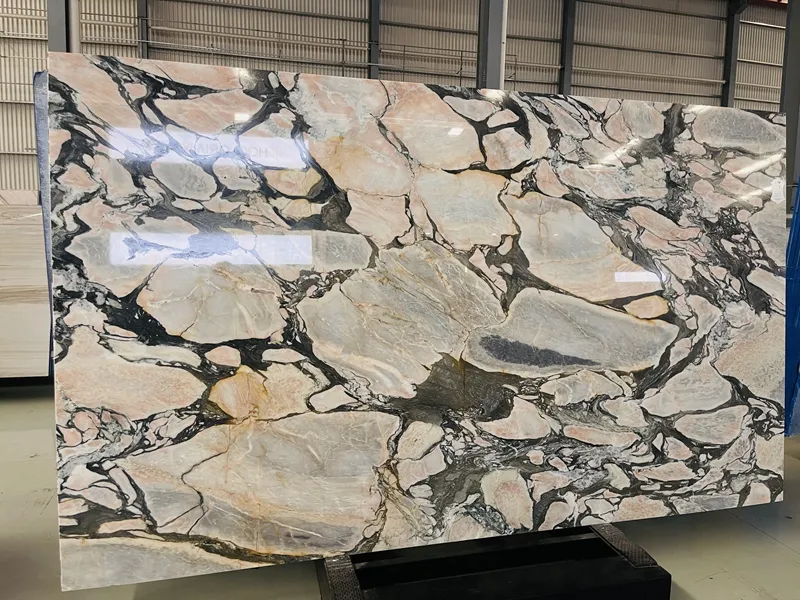
Calacatta Gold Vein Characteristics: Color, Flow, and Visual Impact
Warm Golden Veins Against a Luminous White Background
Calacatta Gold is defined by warm, golden-beige veins sweeping across a luminous white base—bright, crystalline, and near-uniform in clarity. This high-purity background amplifies the richness of the veins, which range from soft honey to deep amber, often accented by subtle grey wisps from trace graphite. The contrast is harmonious rather than stark, evoking fine brushstrokes on a pristine canvas. Because the white field lacks mottling or clouding, every golden thread stands out with exceptional definition, lending depth and movement to the surface. This visual dynamism makes Calacatta Gold ideal for statement kitchen islands and bathroom feature walls—where it anchors the space without dominating it. Its warmth bridges design eras effortlessly, complementing both contemporary minimalism and traditional elegance with organic opulence.
Variability in Vein Thickness, Direction, and Branching Complexity
No two Calacatta Gold slabs are identical—a hallmark of its metamorphic origin. Vein thickness varies dramatically within a single slab, from hair-fine lines to bold strokes several centimeters wide. Directionality is equally unpredictable: veins may flow horizontally, meander diagonally, or cascade vertically. Branching complexity adds further distinction—some remain solitary; others fork into intricate, root-like networks that suggest natural chaos rather than repetition. This variability arises from mineral-rich fluids migrating through fractures in limestone under intense heat and pressure during regional metamorphism. The resulting patterns are geological fingerprints—unrepeatable and inherently expressive. For designers, this means each installation tells a unique story. While slab selection requires careful attention to seam alignment—especially across large surfaces—the payoff is a surface that feels alive, drawing the eye with evolving contours and quiet narrative tension.
Contrast and Rhythm: How Vein Intensity Defines Calacatta Gold’s Design Presence
Vein intensity governs Calacatta Gold’s visual rhythm—the interplay of bold and quiet zones that creates movement across the surface. Slabs with dense, high-contrast networks deliver dramatic presence, anchoring a room like built-in sculpture. Those with sparser, gently flowing veins offer refined understatement, allowing architecture or furnishings to share focus. This rhythmic quality enables intentional spatial orchestration: a heavily veined section can serve as a focal artwork, while quieter areas provide visual breathing room. Success hinges on contextual calibration—intense veining commands attention in minimalist interiors, whereas softer expressions integrate gracefully into layered, textural spaces. Thoughtful application—such as tracing a vein’s descent along a waterfall edge or mirroring a central burst through bookmatching—lets the stone’s natural cadence guide perception. Ultimately, Calacatta Gold transforms functional surfaces into curated design statements grounded in geologic authenticity.
Geological Origins of Calacatta Gold’s Signature Veining
Iron Oxides and Graphite: The Minerals Behind Calacatta Gold’s Warm Veins
The warm golden veins in Calacatta Gold stem primarily from iron oxides—specifically goethite and limonite—formed when iron-rich fluids infiltrated limestone fractures during metamorphism. The degree of iron oxidation and hydration determines hue intensity: pale champagne tones reflect lower oxidation states, while deeper amber signals higher concentrations and more advanced mineral transformation. Graphite, a naturally occurring form of carbon, appears occasionally as fine grey wisps or delicate shading, adding tonal contrast and visual depth. Unlike marbles colored by hematite (which yields reds), Calacatta Gold’s distinctive palette emerges from the specific geochemical conditions of its formation—namely, moderate oxygen availability and sustained thermal pressure. These impurities were originally present in the marine limestone precursor and were redistributed along grain boundaries and fracture planes during recrystallization, producing veins with subtle translucency and light-responsive shimmer.
Metamorphic History and Local Impurity Distribution Shape Unique Vein Patterns
Calacatta Gold originated as limestone deposited in a shallow, warm marine environment—rich in calcium carbonate but also containing trace iron compounds and organic matter. During regional metamorphism, intense heat and pressure caused calcite recrystallization into marble, while impurities were mobilized along stress-induced fractures and cleavage planes. Fluid pathways, rock permeability, and localized stress fields dictated where and how iron oxides and graphite accumulated—resulting in veins of varying thickness, continuity, and branching complexity. Areas of higher impurity concentration yielded bold, sweeping veins; sparser zones produced feathery, linear traces. The resulting patterns—including parallel bands, concentric arcs, and fluid curves—are direct records of subsurface fluid dynamics and tectonic history. Each slab thus reflects the precise geologic conditions of its quarry location—a fact verified through quarry documentation required for authentic Calacatta Gold sourcing.
Calacatta Gold vs. Other Calacatta Variants: Key Vein Differences
While all Calacatta marbles share a luminous white base, their vein character reveals distinct geological signatures. Calacatta Gold—often aligned with the premium Calacatta Oro—is distinguished by warm, honey-to-amber veins that move with bold, fluid gestures. Calacatta Borghini shares similar gold tones but typically displays denser, more dominant veining that can overwhelm smaller spaces. In contrast, Calacatta Vagli and Belgia offer restrained elegance: thinner, quieter veins that preserve luminosity without sacrificing sophistication.
The most pronounced differences arise from mineral composition. Calacatta Viola derives its name from violet-hued veins formed by manganese impurities, while Calacatta Statuario features wide, cool-toned graphite veins that lend architectural rigor and sculptural clarity. These variations are not stylistic choices but geological facts—dictated by the proportion and distribution of iron oxides, graphite, and other trace elements during metamorphism. Design intent guides selection: Calacatta Gold’s warmth softens and unifies a space; Statuario’s sharp grey contrast delivers precision and gallery-like focus. Authenticity is non-negotiable—reputable suppliers provide quarry documentation verifying origin, safeguarding against mislabeled or commercially diluted material.
Design Applications: Leveraging Calacatta Gold’s Natural Veins Effectively
Bookmatching and Seam Placement to Enhance Calacatta Gold’s Visual Continuity
Bookmatching—where adjacent slabs are mirrored like open pages—maximizes Calacatta Gold’s inherent flow, transforming countertops, backsplashes, or wall cladding into seamless compositions. Success depends on precise seam placement: fabricators must align golden veins across joints so transitions disappear visually, preserving the illusion of uninterrupted movement. This technique elevates the stone beyond material into art—its luminous base and warm veining coalescing into a singular, rhythmic gesture. Strategic layout planning—based on each slab’s unique vein trajectory—ensures continuity across large surfaces and reinforces spatial harmony. When executed with expertise, bookmatching doesn’t just showcase Calacatta Gold—it honors its geologic narrative, letting natural rhythm become architectural language.
FAQ
What makes Calacatta Gold unique compared to other marbles?
Calacatta Gold is distinguished by its warm golden-beige veins set against a luminous white base. The veins range in thickness and direction, creating unique, visually dynamic patterns ideal for statement designs.
What is the source of Calacatta Gold’s golden veins?
The warm golden tones are primarily due to iron oxides like goethite and limonite that infiltrated limestone fractures during metamorphism. Graphite often adds subtle grey wisps for added depth.
Is Calacatta Gold suitable for bookmatching?
Yes, Calacatta Gold is highly suitable for bookmatching, allowing its natural veining to flow seamlessly across surfaces, creating breathtaking visual continuity.
How does Calacatta Gold compare to other Calacatta marble variants?
While all Calacatta marbles share a white base, Calacatta Gold features warm veins, unlike the violet hues of Calacatta Viola or the cool grey veins of Calacatta Statuario. Each has its distinct geological signature that caters to varied design intentions.
How do mineral impurities influence Calacatta Gold’s appearance?
Iron oxides and graphite impurities during the marble’s metamorphic formation contribute to the golden and grey veining patterns, adding warmth, depth, and unique visual character.