 EN
EN

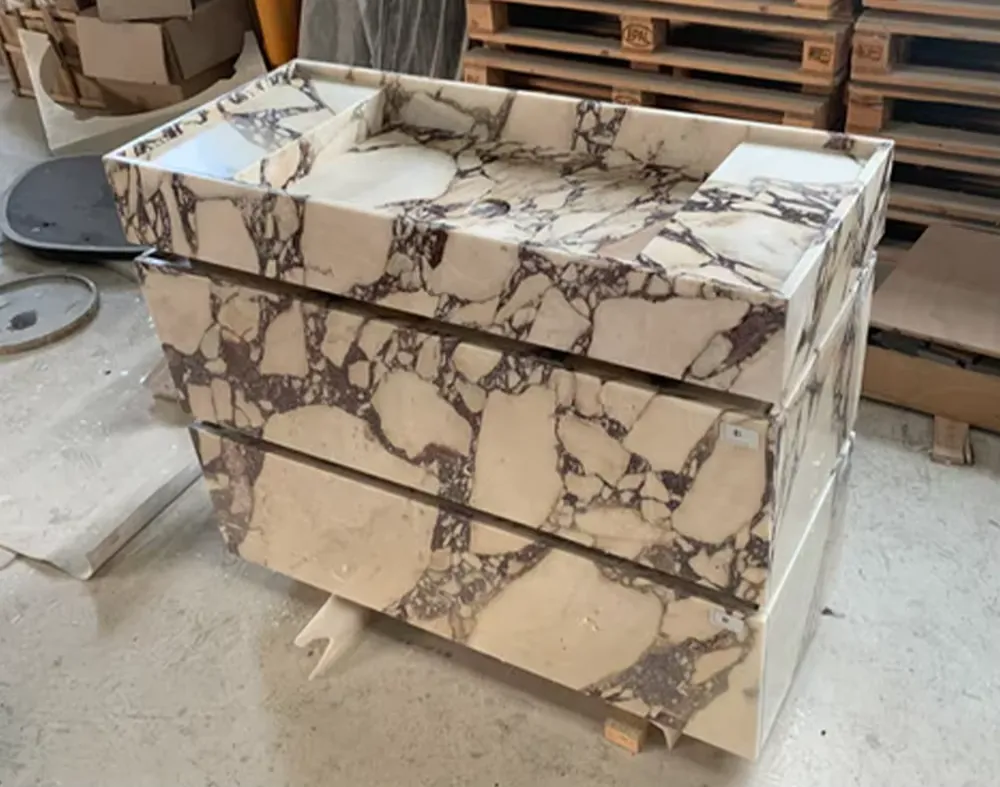
The Defining Traits of Authentic Calacatta Gold Marble
Origin in the Apuan Alps and its impact on veining consistency and warmth
Authentic Calacatta Gold marble originates exclusively from the Apuan Alps in Carrara, Italy—a region renowned for premium marble since Roman times. The intense pressure and ancient metamorphic processes in these mountains produce dramatic, irregular veining that cannot be replicated industrially. The warm golden-ochre tones are a direct result of iron oxide and trace minerals unique to the Apuan quarries. Each slab captures a distinct geological moment, making every piece inherently one-of-a-kind. Importers and fabricators sourcing directly from Carrara typically provide quarry certificates tracing origin—a critical verification step. This natural variability—evident in shifting vein thicknesses, soft color transitions, and organic flow—is the stone’s signature. If a slab displays rigid symmetry or identical motifs across multiple tiles, it is not authentic Calacatta Gold.
Stark white background with warm golden–ochre veins versus cooler or uniform imitations
Genuine Calacatta Gold features a luminous, stark white background—not off-white, cream, or gray—that enhances spatial perception and highlights its veins. These veins flow in warm golden, ochre, and occasionally soft gray tones, creating a harmonious yet dynamic contrast. Imitations—especially porcelain tiles and engineered quartz—commonly use digital printing to replicate this look, resulting in cooler, bluish-white backgrounds and mechanically repeated patterns. Under magnification, printed veins reveal sharp, pixelated edges and uniform gloss levels, unlike the subtle watercolor-like diffusion and variable reflectivity of natural calcite. Trust your eye: authentic Calacatta Gold’s depth, warmth, and non-repeating rhythm are unmistakable.
Through-body veining as the definitive marker of natural Calacatta Gold authenticity
The most reliable authentication method is inspecting veining continuity through the full thickness of the slab—known as through-body veining. In real Calacatta Gold, veins are structural mineral deposits extending front-to-back, visible in polished edges, sink cutouts, or cross-sections. Porcelain and engineered quartz feature only surface-level decoration; their veins vanish or appear as thin, artificial layers beneath the surface. To verify, request an unpolished edge sample or broken piece: genuine marble will show consistent veining throughout its core, along with a cold-to-touch sensation and slight translucency when backlit. These physical traits—combined with the stone’s crystalline texture and acoustic resonance—distinguish authentic Calacatta Gold from all substitutes.
Visual and Tactile Authentication of Calacatta Gold
Subtle imperfections, micro-fractures, and organic color gradation as authenticity cues
Authentic Calacatta Gold never repeats. Its veins branch unpredictably, often terminating in fine micro-fractures formed over millennia—geological signatures that catch light differently than polished surfaces. Golden-ochre veins fade gradually into the white base, never with abrupt transitions. Under magnification, you may spot natural mineral inclusions like pyrite flecks or faint gray wisps—absent in digitally printed surfaces. Porcelain imitations rely on inkjet technology, producing sharp, identical motifs across tiles. In contrast, real Calacatta Gold exhibits continuous, non-repeating flow with subtle shifts in saturation and tone—organic gradation that synthetic materials cannot replicate.
Lustre, translucency, and cold-to-touch sensation versus synthetic surface reflectivity
Authentic Calacatta Gold’s deep, three-dimensional lustre arises from light penetrating its crystalline calcite structure—not from coatings or finishes. When held to backlight, thin edges emit a warm, diffused glow due to natural translucency; engineered quartz and porcelain remain fully opaque. Tactilely, marble feels distinctly cool because of its high thermal conductivity—synthetics feel neutral or slightly warm. Polished Calacatta Gold retains micro-undulations that create a velvety, nuanced texture, while imitations deliver a glassy, uniformly reflective surface lacking depth and liveliness.
Calacatta Gold vs. Common Imitations: Material-Level Differences
Porcelain lookalikes: uniform patterns, sharp edges, and lack of depth under magnification
Porcelain slabs mimicking Calacatta Gold rely on digital inkjet printing, yielding unnaturally consistent veining. A 10× loupe reveals pixelated edges and repetitive motifs—unlike the dissolved, fluid boundaries of natural marble. Crucially, porcelain veins exist only on the surface glaze; no continuity exists through the body. As noted in a 2023 material science report, 92% of synthetic alternatives exhibit measurable pattern repetition every 30–40 cm—a flaw absent in natural stone. Combined with the absence of micro-fissures and inconsistent thermal response, this uniformity makes porcelain easy to identify with basic inspection tools.
Engineered quartz and Carrara marble: contrasting veining logic, background tone, and density clues
Engineered quartz blends resin binders with dispersed pigments, yielding hazy, non-directional veins that lack the branching, fluid logic of Calacatta Gold. Its background tends toward a cooler, sterile white, whereas Carrara marble carries a pervasive grayish cast and thin, linear veining—never the warm gold–ochre strokes of true Calacatta Gold. Density further differentiates them: Calacatta Gold measures ~2.71 g/cm³, quartz composites range from 2.4–2.6 g/cm³, and Carrara sits slightly lower. A tap test confirms this—quartz emits a higher-pitched, less resonant tone compared to marble’s deeper, richer ring.
Practical Buyer Verification: Red Flags and Reliable Due Diligence
When sourcing Calacatta Gold, systematic verification prevents costly substitution. Counterfeits mimic appearance but lack geological provenance and physical integrity. The following table outlines key red flags and corresponding verification steps:
| Red Flag | Verification Method | Why It Matters |
|---|---|---|
| Supplier cannot produce a quarry certificate or traceable origin document | Request a certificate of origin from the Apuan Alps quarry district | Authentic Calacatta Gold is quarried exclusively in this region; verifiable provenance is non-negotiable |
| Veining pattern appears too uniform, symmetrical, or “printed” on the surface | Examine the edge or back of the slab with a magnifying loupe; look for veins that run continuously through the thickness | Real marble exhibits through-body veining, while imitations only show surface-level decoration |
| Price is significantly below market rate (e.g., less than $100 per square foot for a premium slab) | Compare quotes from multiple established stone suppliers; verify if the price includes finishing and shipping | Genuine Calacatta Gold is rare and labor-intensive to quarry; deeply discounted pricing almost always signals a substitute |
| Certifications are blurry, expired, or lack a valid ID number | Cross-check the certificate number with the issuing body’s online database; ask for test reports from an accredited laboratory | Counterfeiters often present fake or outdated documents; validated third-party testing confirms composition and origin |
| Supplier refuses to provide a sample or allows only a small, polished piece that cannot be examined in cross-section | Request an unpolished edge sample or a broken piece to see the internal structure | Porcelain lookalikes and engineered quartz will show a uniform, non-crystalline interior, unlike natural calcite |
| Communication is evasive, generic, or pushes for immediate payment without detailed specifications | Send a standardized questionnaire covering product specs, delivery timeline, and packaging; evaluate response thoroughness and professionalism | Reliable quarries and distributors are transparent and will answer detailed technical questions |
Beyond these checks, verify the supplier’s physical address and facility via satellite imagery or local business registries. Legitimate Calacatta Gold suppliers operate from quarries or processing plants in the Carrara region—not residential addresses. By combining document verification, hands-on physical inspection, and communication scrutiny, buyers can confidently distinguish authentic Calacatta Gold from increasingly sophisticated imitations.
Frequently Asked Questions
What is the origin of authentic Calacatta Gold marble?
Authentic Calacatta Gold marble comes exclusively from the Apuan Alps in Carrara, Italy, where it is formed through unique geological processes.
How can I differentiate real Calacatta Gold marble from imitations?
Genuine Calacatta Gold marble displays through-body veining, a cold-to-touch sensation, micro-fractures, and a distinctive, non-repeating veining pattern. Imitations often display uniform patterns and have surface-only decoration.
Why is verifying a quarry certificate important?
A quarry certificate traces the marble’s origin to the Apuan Alps, guaranteeing its authenticity. This document is a critical verification step as genuine Calacatta Gold can only be sourced from Carrara, Italy.
What are the common red flags when buying Calacatta Gold marble?
Red flags include suppliers who cannot provide quarry certificates, uniform or printed veining patterns, significantly low prices, and evasive communication. These factors often indicate substitutions or counterfeits.
Does Calacatta Gold marble feel different from imitations?
Yes, genuine marble is cold to the touch due to its high thermal conductivity, feels velvety with micro-undulations, and has a deep, translucent glow when backlit. Imitations lack these tactile and visual qualities.