 EN
EN

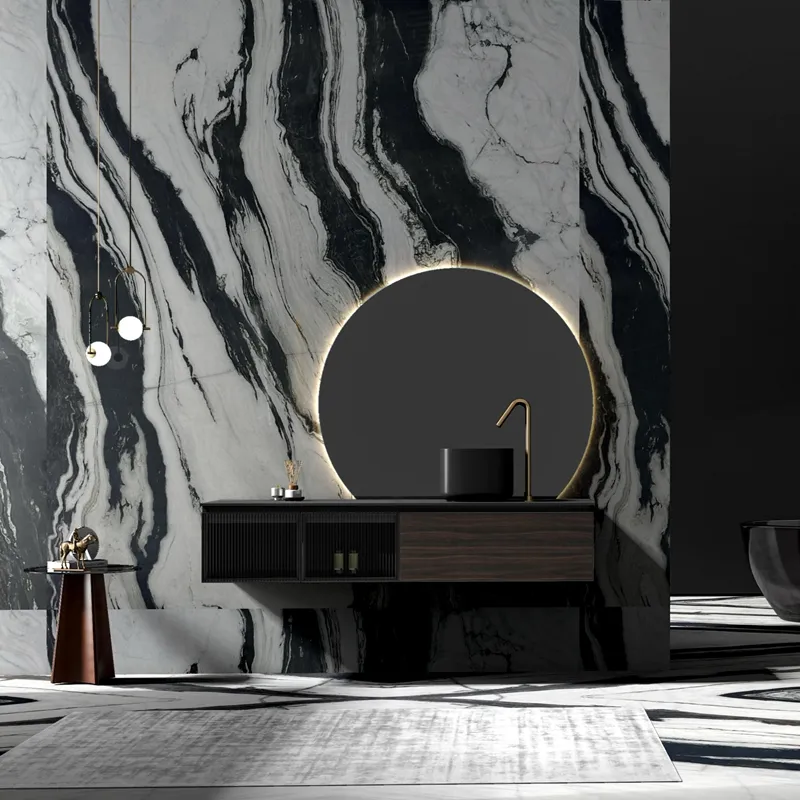
Exceptional Heat Resistance and Enhanced Fire Safety
Fire-rated thermal stability: How marble’s natural composition meets and exceeds building code requirements for fireplace surrounds
Marble achieves inherent fire-rated thermal stability through its natural mineral composition—primarily calcite—a non-combustible, thermally stable compound. Under standardized testing per EN 13501‑1, marble consistently earns an A1 fire classification: the highest rating for building materials, confirming it contributes no fuel to fire and emits negligible smoke. ASTM E84 testing further validates this performance, with marble typically registering a 0/0 flame spread and smoke-developed index—well below the Class A threshold of 25/450. This means marble will not ignite, propagate flame, or release toxic fumes—even when exposed to temperatures exceeding 750 °C (1,382 °F) for over 30 minutes. Such resilience directly satisfies—and often surpasses—the non-combustible clearance requirements of the International Building Code and NFPA 211. Unlike metal surrounds, which frequently require thermal barriers, ventilation gaps, or additional fire-stopping measures, marble’s monolithic structure inherently fulfills code-mandated fire-resistance ratings without modification. Its thermal stability remains uncompromised over decades, delivering passive, long-term protection for both structure and occupants.
Thermal behavior comparison: Marble’s low conductivity vs. metal’s rapid heat transfer and surface risk
Thermal conductivity highlights a fundamental safety advantage: marble’s value sits at approximately 2.5 W/mK—far lower than steel (≈15–50 W/mK) or aluminum (≈200 W/mK). During fireplace operation, metal surrounds rapidly absorb and conduct heat outward, raising surface temperatures beyond 60 °C (140 °F)—a threshold capable of inflicting second-degree burns in under three seconds, particularly hazardous for children and pets. Marble’s dense crystalline matrix significantly slows heat transfer, keeping the outer surface cooler and safer to touch. This thermal lag also enables gradual absorption and radiation of heat, minimizing abrupt temperature fluctuations. Crucially, repeated thermal cycling causes metals to expand and contract unevenly—leading to warping, joint failure, and coating degradation—while marble’s low coefficient of thermal expansion (5–8 × 10⁻⁶/°C) preserves dimensional integrity over time. Where metal surrounds often necessitate protective screens or warning labels, marble delivers built-in burn mitigation—aligning with the proactive, human-centered safety principles advocated by the National Fire Protection Association and other fire safety authorities.
Timeless Aesthetic Value and Design Flexibility
Natural elegance of marble: Veining, luminosity, and prestige that elevate interior architecture
A marble fireplace instantly becomes the architectural heart of a room—offering permanence, artistry, and tactile sophistication unattainable with engineered materials. Each slab bears unique veining patterns formed by trace minerals over millions of years, ensuring no two surrounds are identical. This organic variation lends a hand-sculpted, gallery-worthy presence to both residential and commercial interiors. Marble’s natural luminosity further enhances its appeal: polished surfaces reflect ambient light, softening shadows and amplifying the hearth’s warmth and intimacy. Unlike painted or coated metals prone to fading, chipping, or yellowing, marble’s crystalline depth yields a subtle, enduring glow that matures gracefully—not deteriorates—with age. Interior designers consistently select marble to signal refined taste and material intelligence, drawing on its legacy in classical architecture and fine art. As such, a marble fireplace transcends utility—it becomes a sculptural anchor that elevates the entire spatial narrative, independent of fleeting stylistic trends.
Versatile integration: Matching marble fireplace styles—from Carrara to Nero Marquina—with modern, traditional, and transitional interiors
Marble’s design versatility allows it to harmonize across diverse aesthetics without compromise. Light-toned Carrara—featuring soft gray veining on a luminous white ground—complements minimalist, Scandinavian, and coastal schemes by introducing quiet texture and quiet luxury. For high-contrast drama, Nero Marquina’s deep black field and bold white veining commands attention in industrial lofts or monochromatic contemporary spaces. In traditional settings, creamy Botticino or richly striated Calacatta pairs elegantly with wood paneling and ornate mantel profiles. Transitional interiors benefit from honed or leathered finishes, which temper reflectivity while preserving depth—bridging heritage craftsmanship and modern restraint. Shape adaptability further extends marble’s range: a seamless monolithic slab suits clean-lined architecture, while carved, corbelled, or fluted mantels satisfy classical sensibilities. Because marble’s coloration is geological—not chemical—it remains visually consistent across decades, ensuring the fireplace ages with dignity rather than obsolescence. This enduring compatibility makes marble a strategic, future-proof design investment—one that evolves with the homeowner’s style, not against it.
Proven Durability and Minimal Maintenance Over Decades
Thermal cycling resilience: Marble’s structural integrity versus metal fatigue, warping, and coating degradation
Marble withstands thousands of heating-and-cooling cycles without structural compromise. Its tightly bonded crystalline lattice and low coefficient of thermal expansion (5–8 × 10⁻⁶/°C) resist microfracturing and delamination—unlike metals, whose differential expansion under repeated thermal stress leads to warping, joint loosening, and eventual fatigue. As outlined in ASME’s 2021 guidelines for elevated-temperature service, metal components heated above 1,000°F risk progressive strength loss and micro-crack formation—accelerating coating failure and exposing substrates to oxidation. Marble, by contrast, possesses an inert chemical composition and a melting point exceeding 2,400°F. It shows no measurable degradation after decades of residential use—no embrittlement, no off-gassing, and no structural decay—making it uniquely suited for long-term, high-performance fireplace applications.
Effortless upkeep: Non-porous surface resistance to stains and oxidation—unlike metal fireplaces prone to rust and discoloration
When properly sealed, marble develops a dense, non-porous surface highly resistant to soot, moisture, and everyday spills. Routine cleaning requires only a damp microfiber cloth—no abrasives, solvents, or specialized products needed. Metal surrounds, however, are vulnerable to oxidation: even stainless grades can develop rust spots near seams or scratches, demanding frequent polishing, repainting, or panel replacement. Marble resists acid etching from common hearth byproducts (e.g., ash residue, cleaning agents) and shows no heat-induced discoloration or tarnish. Homeowners avoid recurring maintenance costs—no re-finishing, no corrosion remediation, no seasonal prep—and retain the original luster and integrity of the stone for generations. This combination of resilience and simplicity defines marble not just as a finish, but as a genuinely low-maintenance, high-value architectural asset.
Frequently Asked Questions (FAQs)
What makes marble fire-resistant?
Marble’s natural mineral composition, primarily calcite, is non-combustible and thermally stable. It achieves an A1 fire classification and does not ignite, propagate flames, or emit toxic fumes, even at high temperatures.
How does marble perform better than metal fireplaces in terms of safety?
Marble has a low thermal conductivity, which keeps its surface cooler. Unlike metal, it does not transfer heat rapidly or pose a burn risk. Additionally, marble’s thermal stability prevents issues like warping or coating degradation.
Can marble be integrated into different interior styles?
Yes, marble is highly versatile and can complement modern, traditional, and transitional interiors. Its natural veining and various finishes make it adaptable to a wide range of design aesthetics.
Is marble durable for fireplace applications?
Absolutely. Marble’s low thermal expansion, high melting point, and chemical stability ensure it withstands decades of thermal cycling without structural or aesthetic degradation.
How easy is it to maintain a marble fireplace?
Marble is easy to maintain. When properly sealed, it resists stains, soot, and moisture, requiring minimal upkeep with basic cleaning techniques like wiping with a damp microfiber cloth.