 EN

Why Edge Profile Is the Defining Detail for Marble Countertop Aesthetics
How light refraction and shadow play elevate perceived luxury in marble countertop edges
The edge profile of a marble countertop doesn’t just finish the slab—it orchestrates how light reveals the stone’s soul. Unlike a raw 90-degree corner, which casts a hard, unrefined shadow and obscures depth, a thoughtfully shaped edge modulates light to expose marble’s subtle translucence. An eased edge—just a 1/8-inch radius—softens the termination, allowing ambient light to glide evenly across the surface and minimizing contrast beneath the overhang. This directs attention inward, to the veining itself. More complex profiles like the ogee or bevel introduce angled facets that catch and reflect light dynamically, generating rhythmic highlights and soft shadows that add dimensionality. The pinnacle is the mitered edge: where the slab wraps the corner seamlessly, carrying both pattern and luminance down the vertical face. This uninterrupted flow mimics a monolithic block—evoking permanence, craftsmanship, and timeless luxury far beyond standard fabrication.
Tactile hierarchy and visual weight: Why a ½-inch edge transition reshapes spatial perception
A marble countertop’s visual authority stems less from total thickness than from how its edge engages the room. A minimal eased profile supports a floating, minimalist aesthetic—ideal for streamlined modern kitchens. But introducing a deliberate ½-inch transition—whether via a wide bevel, laminated buildup, or mitered wrap—immediately enhances perceived mass and presence. That slight step casts a defined linear shadow along the perimeter, grounding the island like a sculpted plinth. Tactilely, the crisp chamfer registers as intentional detail: fingertips recognize it as a hallmark of fine millwork or custom furniture, subconsciously reinforcing quality and permanence. Without such intentionality, even a thick slab can read as visually thin or unresolved. In essence, this half-inch decision transforms the countertop from a surface into a three-dimensional object—one that commands space with quiet confidence.
Top 5 Marble Countertop Edge Profiles Ranked by Design Impact
Eased bullnose: The modern standard for softness, safety, and slab clarity
The eased bullnose gently rounds both top and bottom edges—removing sharp corners while preserving the slab’s clean rectangular form. It maximizes light reflection across the surface, delivering an unbroken expanse that lets natural veining take center stage. Fabricators apply just enough rounding to improve tactile comfort and reduce chipping risk—a practical necessity given marble’s Mohs hardness of ~3. In high-traffic kitchens or bathrooms, this profile prevents painful bumps and minimizes edge damage. Unlike ornate cuts, it avoids deep crevices where debris accumulates, making cleaning effortless and maintenance intuitive. Its simplicity is strategic: it prioritizes material integrity and clarity without competing for attention—making it the enduring benchmark for modern, stone-forward design.
Ogee, double bevel, and waterfall: Comparing drama, dimensionality, and installation complexity
| Edge Profile | Drama Level | Dimensionality | Installation Complexity | Best Use Case |
|---|---|---|---|---|
| Ogee | High; classic grandeur | Curved S‑shape adds depth | Moderate‑high | Formal kitchens, luxury bathroom vanities |
| Double bevel | Medium‑high | Angled facets create prismatic light play | Moderate | Transitional spaces, contemporary powder rooms |
| Waterfall | Extreme; architectural statement | Vertical slab continuation extends visual mass | High | Kitchen islands, open‑plan designs |
The ogee’s elegant concave-convex sweep delivers refined opulence—but demands precise templating and sufficient slab thickness (ideally 3 cm) to avoid fragile tips. Double bevels offer geometric sophistication: their dual angles catch light from multiple directions, adding shimmer without ornamentation—though sharper corners require mindful daily use. Waterfall edges elevate the countertop to architectural sculpture, extending the slab vertically down island sides; flawless mitered seams and structural reinforcement are non-negotiable, and 3 cm material is typically required to sustain visual weight and stability. Each profile balances expressive impact against real-world constraints—so the optimal choice aligns with both spatial intent and long-term livability.
Matching Edge Design to Marble Characteristics for Maximum Beauty
Aligning edge profile with veining direction, color contrast, and slab thickness (2cm vs. 3cm)
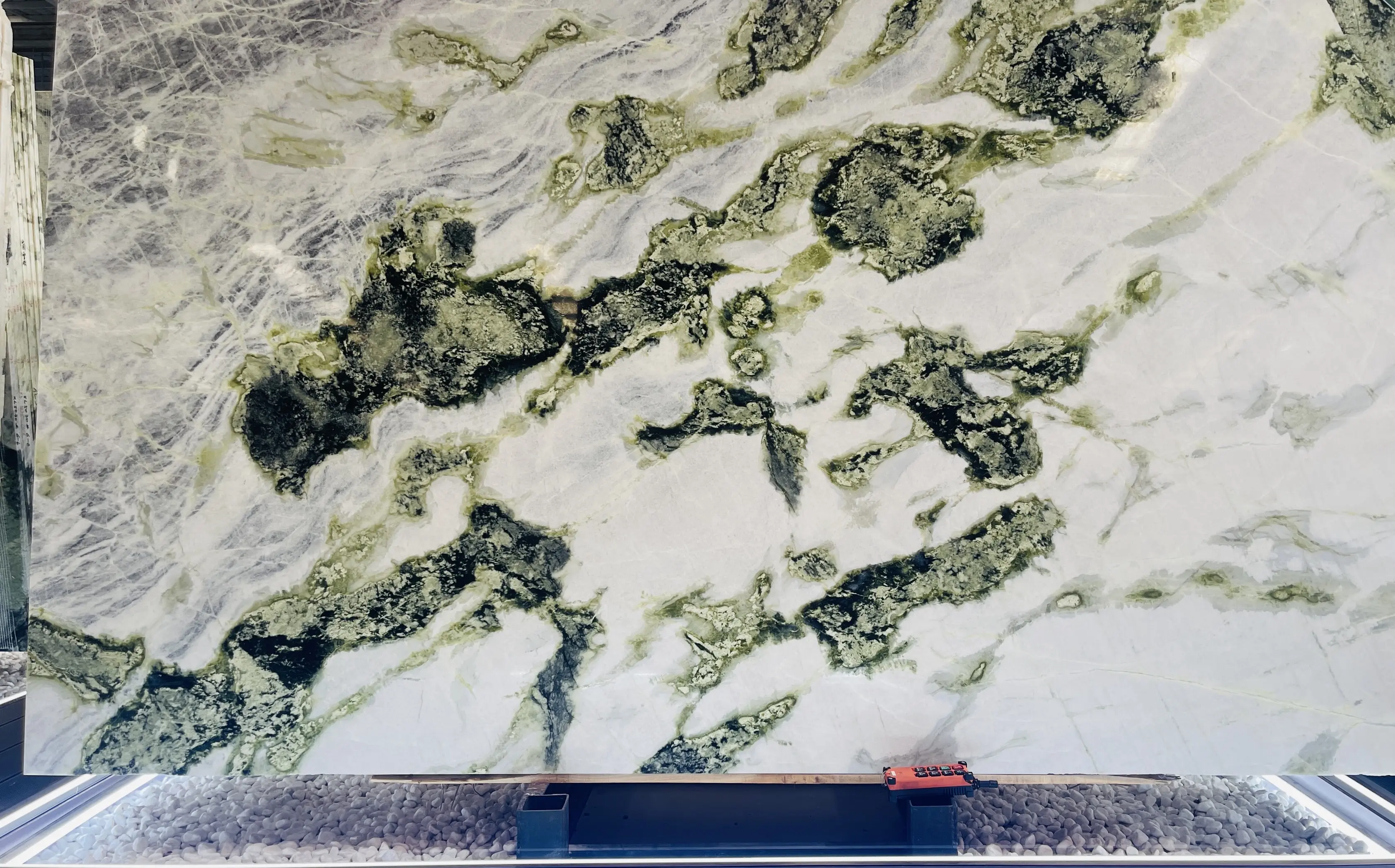
Marble’s beauty lives in its movement—the directional flow of veins, the interplay of tone and contrast, and the inherent weight of the slab. Edge profiles must follow, not interrupt, that logic. Bold, sweeping veins (as in Calacatta or Statuario) thrive with simple, clean profiles—an eased or straight edge allows those lines to travel unbroken across the surface. Quieter marbles like Carrara, with subtler, more uniform patterning, gain definition and interest from sculpted details such as a cove or bevel. Color contrast guides refinement: dark marbles with light veining gain richness from a crisp 45-degree bevel that catches light and deepens tonal separation, while pale stones paired with a soft bullnose yield a gentle, inviting rim. Slab thickness dictates feasibility: 2 cm slabs usually require lamination to support intricate profiles like full ogees or waterfalls without appearing insubstantial; 3 cm slabs carry these forms naturally, lending visual heft and structural confidence. When profile, pattern, and proportion align, the result feels inevitable—not applied.
Case study: Calacatta Viola kitchen — How ogee vs. double bevel transformed tonal balance and elegance
In an open-plan kitchen featuring Calacatta Viola—a dramatic marble with deep purple-burgundy veins on a creamy white ground—the original double bevel edge created sharp, graphic contrast that unintentionally fragmented the stone’s natural rhythm. The angular cut emphasized vein boundaries rather than flow, making the purple marks appear jagged and disjointed. Switching to a classic ogee profile recalibrated the entire composition. Its continuous S-curve captured light in a soft, rolling progression—framing the veining with grace instead of interruption. The purple tones deepened, the white background gained luminosity, and the 3 cm slab’s substantial rim anchored the island with quiet authority. As daylight shifted, the ogee’s subtle shadow line enhanced depth without harshness. This single change didn’t just refine the countertop—it elevated the room’s tonal harmony and emotional resonance. It reaffirmed a core principle: the right edge profile doesn’t finish the marble—it completes the experience.
FAQs
Why is the edge profile important in marble countertops?
The edge profile enhances both aesthetic and functional qualities, shaping how light interacts with the surface, emphasizing veining, and adding visual weight or elegance.
Which marble edge profile suit high-traffic areas?
The eased bullnose profile is ideal for high-traffic spaces as it eliminates sharp corners, minimizes chipping risk, and ensures durability and ease of cleaning.
What edge profiles work best with 2 cm slabs?
Intricate profiles such as ogees or waterfalls often require lamination for 2 cm slabs to maintain visual and structural strength.