 EN
EN

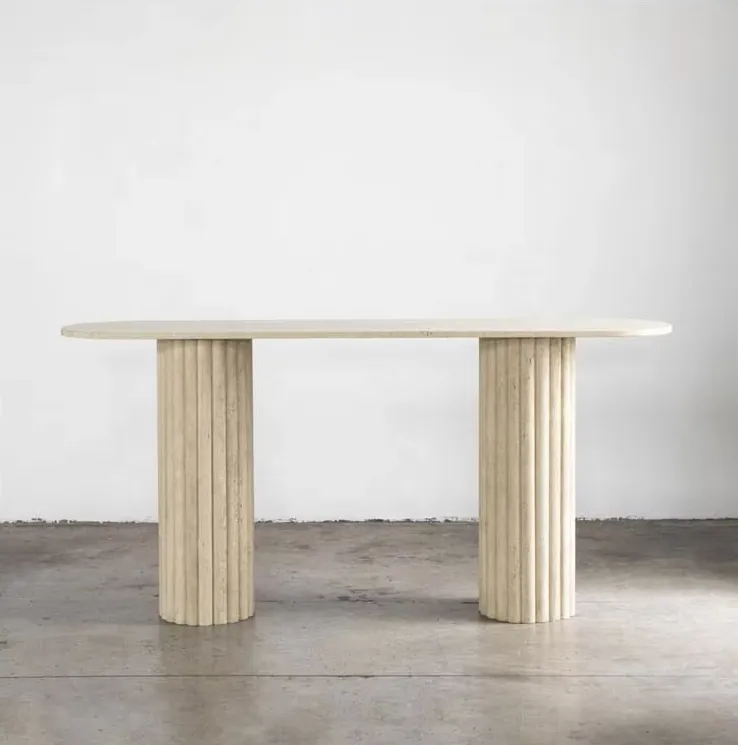
Travertine Grades and Structural Suitability for Tables
Grade A vs. Grade B: Balancing Visual Consistency and Functional Resilience
Grade A travertine delivers greater visual uniformity—fewer veins, smaller and less frequent pores—which directly supports structural integrity for load-bearing applications like dining tables. With fewer natural fissures, Grade A slabs resist cracking under daily use and concentrated weight. Grade B offers more character—pronounced veins, larger pores, and subtle color variations—but those features can introduce weak points. While Grade B is often more budget-friendly, it remains viable for table use if the slab is at least 3 cm thick and supported by a rigid, well-engineered base. The decision hinges on balancing aesthetics with functional resilience. A trusted supplier will disclose grade information and confirm suitability for structural applications—critical guidance that helps prevent premature failure.
Vein Pattern, Density, and Natural Pore Distribution — How They Influence Load-Bearing Stability
Travertine’s vein patterns are not merely decorative; they indicate zones of natural separation within the stone. Long, continuous, or intersecting veins compromise tensile strength and increase fracture risk under point loads. Density correlates strongly with compressive resistance: denser slabs—those with minimal voids—distribute weight evenly and resist flexing under heavy loads. Unfilled pores, especially in cross-cut travertine, act as stress concentrators; placing weight over them can initiate micro-cracks that propagate over time. To enhance stability, select a honed or filled finish for the tabletop surface. Many manufacturers reinforce the underside with fiberglass mesh backing—a proven method to improve flexural strength. Visually inspect slabs for edge-to-edge dark veins, which pose the highest failure risk. A thoughtfully selected slab—dense, well-veined, and properly finished—ensures even load distribution and long-term durability.
Travertine Finish Types and Their Impact on Table Safety and Use
Honed, Polished, Tumbled, and Brushed: Slip Resistance and Surface Durability by Setting
A travertine table’s finish shapes both its safety profile and practical performance. The table below compares four common finishes across key functional criteria:
| Finish Type | Surface Appearance | Slip Resistance | Durability & Scratch Visibility | Best Table Setting |
|---|---|---|---|---|
| Honed | Smooth, matte | Good | Scratches less visible; may stain faster if unsealed | Dining tables, low‑traffic areas |
| Polished | Glossy, reflective | Low | Scratches show easily; resists stains when sealed | Formal accent tables, light‑use surfaces |
| Tumbled | Rustic, textured | Excellent | Hides marks well; textured surface can trap dirt | Outdoor tables, high‑traffic spaces |
| Brushed | Subtly textured, natural | Moderate | Good scratch camouflage; moderate cleanability | Entryway tables, casual settings |
Honed and brushed finishes strike the most practical balance—offering reliable traction and forgiving surface characteristics ideal for everyday dining. Polished finishes demand deliberate care to maintain their elegance, while tumbled textures excel outdoors but require periodic deep cleaning to remove debris from crevices. Regardless of finish, applying a penetrating sealer significantly improves stain resistance and preserves surface integrity—essential for sustaining both safety and appearance over time.
Filled vs. Unfilled Travertine: Trade-offs in Cleanability, Sealing Frequency, and Aesthetic Authenticity
Filled travertine has its natural voids sealed with resin or cement-based filler, yielding a smooth, consistent surface that resists liquid penetration and simplifies routine cleaning. This treatment reduces sealing frequency—typically every 2–3 years for daily-use tables—making it the pragmatic choice for functional furniture. Unfilled travertine retains its raw, porous texture, offering unmatched authenticity and organic charm. Yet those open pits readily absorb spills and trap debris, requiring more frequent sealing (often annually) and meticulous maintenance to avoid staining or discoloration. For a table expected to handle meals, beverages, and daily activity, filled travertine provides the optimal blend of durability, hygiene, and ease of care. Unfilled variants shine best in decorative or low-contact contexts where patina development is part of the design intent.
Porosity, Stain Vulnerability, and Realistic Sealing Requirements for Travertine Tables
Travertine’s sedimentary origin—formed by mineral deposits from natural springs—gives it an inherently porous structure. Under magnification, its network of microscopic channels and voids makes it vulnerable to absorption. Without protection, liquids like red wine, coffee, cooking oil, or even water can penetrate the surface, causing permanent stains, etching, or microbial growth in trapped moisture. Acidic substances—including citrus juice and vinegar—are especially damaging: they react with travertine’s calcium carbonate matrix, dulling the finish and leaving lightened, rough etch marks.
Sealing is the essential safeguard. A high-quality penetrating sealer bonds within the stone’s capillaries, blocking oil and water absorption without forming a surface film—preserving breathability and natural appearance. For a daily-use table, resealing every 1–3 years is realistic, depending on sealer formulation and cleaning intensity. Test seal integrity with the water-bead test: if droplets bead and remain intact for 10+ minutes, protection is effective; if they darken or soak in within seconds, resealing is due. Between treatments, immediate spill response is non-negotiable—blot gently, never wipe. Coasters, placemats, and felt pads minimize direct contact risks. Routine cleaning requires only pH-neutral, stone-safe solutions; abrasive tools or acidic or alkaline cleaners degrade sealers and erode the surface. These practices keep stain vulnerability low and ensure lasting function and beauty.
Daily Durability: Scratches, Heat, and Wear Resistance in High-Use Table Environments
Mohs Hardness (3–4) in Context: Common Household Threats and Mitigation Strategies
With a Mohs hardness of 3–4, travertine sits alongside marble and limestone—soft enough that steel keys (~5.5), ceramic dishware (~7), and even gritty dust can cause visible abrasion. Its vulnerability lies not in isolated incidents but in cumulative friction: sliding laptops, dragging centerpieces, or repeated contact with unbuffered objects accelerates uneven wear. While a gentle patina develops naturally over time, unmanaged abrasion leads to premature dulling or surface degradation. Prevention is straightforward and highly effective: use coasters, placemats, and soft-bottomed accessories consistently. Wipe up sandy residue immediately—it functions like fine sandpaper on the surface. Though sealing doesn’t increase hardness, a quality penetrating sealer helps prevent particulates from lodging in micro-pores. Adopting these habits allows a travertine table to retain both structural soundness and refined appearance across decades of active use.
Thermal Limits and Thermal Shock Risks: Why Even Thick Travertine Tables Need Trivets
Travertine tolerates moderate heat but remains susceptible to thermal shock—the rapid, uneven expansion caused by sudden temperature differentials. Placing a hot pan directly onto a cool stone surface creates internal stress: the surface layer expands while the core stays contracted, potentially generating invisible micro-fractures that worsen with repeated exposure. This risk persists regardless of slab thickness—even 3 cm slabs can crack when a 400°F cast-iron skillet meets a 60°F tabletop. Always use trivets, insulated mats, or folded cloths as thermal buffers. Avoid setting oven-hot stoneware directly on the surface. Brief contact with warm mugs poses negligible risk, but sustained, direct heat from cookware is never advisable. Consistent use of protective barriers preserves both visual continuity and structural reliability—keeping your travertine table safe and stable for generations.
FAQ
What is the difference between Grade A and Grade B travertine?
Grade A travertine offers greater visual uniformity, fewer veins, and smaller pores, enhancing structural integrity for tables. Grade B, while more affordable and featuring pronounced veins and character, requires thicker slabs for stability and proper engineering for table applications.
How often should I seal a travertine table?
Sealing frequency depends on usage and the type of travertine. Filled travertine typically requires sealing every 2–3 years, while unfilled travertine may need annual sealing to protect against spills and stains.
Can travertine resist heavy loads on a table?
Yes, provided you choose a dense, well-veined slab with minimal voids. Reinforcements like fiberglass mesh backing and honed finishes further enhance stability and load-bearing capacity.
What precautions should I take to avoid scratching travertine tables?
Use coasters, placemats, and avoid sliding objects directly across the surface. Cleaning dust and grit promptly can prevent fine scratches over time.
How can I protect my travertine table from heat damage?
Always use trivets, insulated mats, or cloths under hot cookware to avoid thermal shock. Sudden temperature changes can stress the stone and lead to cracking.
What is the best finish for everyday use travertine tables?
Honed and brushed finishes are ideal for everyday use due to their good slip resistance, forgiving surface durability, and ease of maintenance.
Table of Contents
- Travertine Grades and Structural Suitability for Tables
- Travertine Finish Types and Their Impact on Table Safety and Use
- Porosity, Stain Vulnerability, and Realistic Sealing Requirements for Travertine Tables
- Daily Durability: Scratches, Heat, and Wear Resistance in High-Use Table Environments
-
FAQ
- What is the difference between Grade A and Grade B travertine?
- How often should I seal a travertine table?
- Can travertine resist heavy loads on a table?
- What precautions should I take to avoid scratching travertine tables?
- How can I protect my travertine table from heat damage?
- What is the best finish for everyday use travertine tables?