 EN
EN

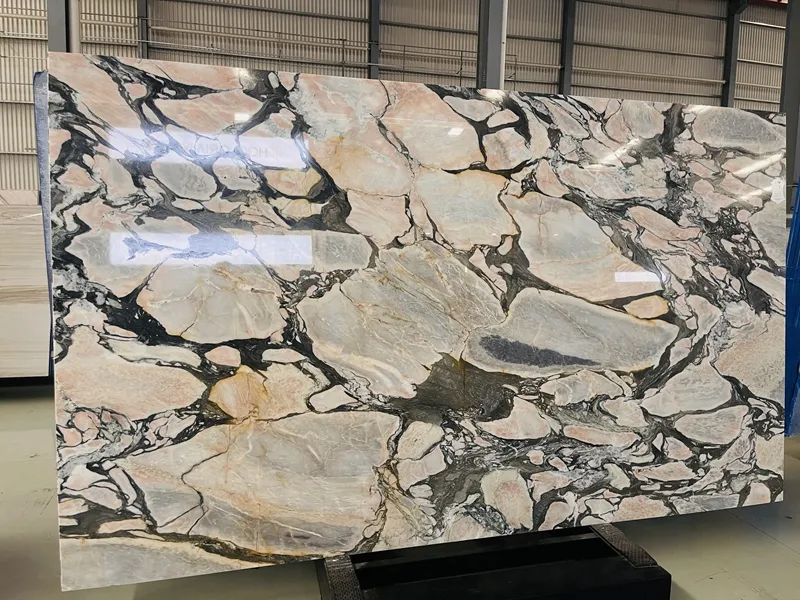
Calacatta Gold in Villa Kitchens: Balancing Luxury, Function, and Scale
Countertops and Islands: Selecting Slabs for Visual Impact and Structural Integrity
Selecting Calacatta Gold slabs for villa kitchen countertops and islands demands a careful balance between dramatic aesthetics and robust engineering. Its distinctive veining—ranging from delicate gold threads to bold, sweeping strokes—can transform a large island into a breathtaking focal point. To maximize visual harmony, designers often book-match slabs, aligning vein patterns across seams for a continuous, expansive look. A 2023 report by the Natural Stone Institute confirms that marble surfaces, when properly sealed, can endure over 50 years of daily use—provided structural best practices are followed.
For kitchen islands, jumbo slabs (up to 130 by 77 inches) minimize seams and preserve the unbroken flow of gold veining—ideal for villa-scale spaces. However, this requires reinforced cabinetry, precise digital templating, and a perfectly level substrate to prevent stress fractures. Slabs must be at least 3 cm thick to support overhangs, and fabricators should inspect for natural fissures and fill them with epoxy resin. Choosing a slab with balanced contrast—neither too dense nor too sparse in veining—enhances luxury without visual fatigue. The result is a surface that feels both opulent and engineered for longevity.
Backsplashes and Integrated Elements: Tile vs. Slab Solutions for Seamless Flow
Extending Calacatta Gold to backsplashes and integrated panels ensures a seamless visual flow from countertop to wall—but the choice between tile and slab solutions shapes both aesthetic impact and long-term practicality.
| Aspect | Tile Solution | Slab Solution |
|---|---|---|
| Visual Continuity | Grout lines interrupt the veining pattern, creating a segmented look | A single slab offers an unbroken, mural-like expanse of gold veining |
| Installation | Easier to handle and cut, reducing labor complexity | Requires precise templating and heavy-lifting equipment |
| Grout Maintenance | Grout can stain and require periodic sealing in kitchen environments | Fewer grout lines mean less cleaning and a more hygienic surface |
| Cost | Generally lower material cost, but more labor for layout | Higher material cost but fewer seams and a premium, gallery-like finish |
In villa kitchens, full-height slab backsplashes behind the range or continuous slab panels on primary walls serve as statement elements—amplifying light, reinforcing spatial grandeur, and elevating the perception of scale. Tile may be reserved for secondary zones where budget or logistical constraints apply. Ultimately, the decision should reflect the villa’s design intent: slab solutions prioritize cohesion and luxury; tile offers flexibility and pragmatic adaptability.
Calacatta Gold in Villa Bathrooms: Performance and Aesthetic Adaptation
Vanities, Shower Enclosures, and Wet-Area Cladding: Moisture Resistance and Joint Management
In villa bathrooms, Calacatta Gold’s dramatic veining elevates vanity tops and wet-area surfaces—but its performance hinges on proactive moisture management. For vanities, selecting book-matched slabs with minimal natural fissures and applying a premium penetrating sealer—per Natural Stone Institute guidelines—reduces water absorption to under 0.05%, significantly limiting staining risk. In shower enclosures, large-format tiles or slab panels are preferred over standard mosaics: they reduce grout line density, the most common entry point for moisture. Where joints are unavoidable, epoxy-based grouts are essential; the Tile Council of North America notes they decrease joint-related water ingress by up to 90% compared to cementitious alternatives.
For full-height wet-area cladding—such as shower walls or steam-room surrounds—a slight slope toward the drain and continuous perimeter sealing further protect the stone’s integrity. These measures ensure the golden veins remain vivid and unblemished, merging high-end aesthetics with real-world resilience in humid, high-use environments.
Architectural Integration Across Villa Spaces: Floors, Walls, and Proportional Harmony
Large-Format Slab Flooring and Feature Walls: Enhancing Spatial Perception and Light Reflection
Calacatta Gold’s luminous white backdrop and bold gray-gold veining naturally amplify space and light when deployed in large-format slabs. By minimizing grout lines—often reducing them by up to 80% versus smaller tiles—these slabs create near-uninterrupted surfaces that visually extend floor and wall planes. In villa-scale environments, a single 3-meter-long bookmatched run on a feature wall reinforces proportional harmony, drawing the eye upward and enhancing perceived ceiling height.
On floors, the polished finish reflects up to 30% more ambient light than matte alternatives—a property shown in a 2022 interior design study to increase perceived room volume by 12%. Crucially, vein continuity across expansive slabs prevents visual fragmentation, ensuring open-plan living areas feel unified rather than disjointed. For optimal effect, orient the stone’s strongest veining along the longest axis of the room—deepening the illusion of depth while maintaining elegance and balance.
Installation and Long-Term Care of Calacatta Gold in High-End Villa Projects
Precision Fabrication, Substrate Readiness, and Advanced Sealing for Villa-Scale Durability
Lasting elegance with Calacatta Gold in expansive villas begins with millimeter-accurate digital templating and waterjet cutting—techniques that minimize seam visibility and mitigate stress fractures during installation. Substrate readiness is non-negotiable: for large islands and floor slabs, deflection must not exceed L/720 under live load, typically requiring reinforced joists or concrete backer boards. Any unevenness risks micro-fracturing over time.
Before installation, a high-quality impregnating sealer—applied in multiple coats—penetrates the stone’s micro-pores to block oil and water without altering its honed or polished character. This barrier, renewed annually, prevents etching from acidic spills and deep-set staining—especially critical in kitchens and steam-filled bathrooms. When paired with proper fabrication, substrate preparation, and consistent maintenance, Calacatta Gold delivers decades of structural soundness and visual distinction—fulfilling its role not just as a finish, but as an enduring architectural signature.
FAQ
Q: What is the best thickness for Calacatta Gold slabs in kitchen countertops?
A: For villa-scale kitchens, slabs should be at least 3 cm thick to support overhangs and ensure durability.
Q: Are book-matched slabs necessary for creating a seamless look?
A: While not necessary, book-matched slabs greatly enhance visual harmony by aligning vein patterns across seams, creating a cohesive and luxurious surface.
Q: How often should I reseal Calacatta Gold surfaces?
A: It is recommended to apply a high-quality impregnating sealer annually to maintain its stain resistance and ensure long-term durability.
Q: Can Calacatta Gold be used in high-moisture areas like bathrooms?
A: Yes, with proper installation and sealing, Calacatta Gold is suitable for wet areas like shower enclosures and steam rooms. Ensure epoxy-based grouts are used for joints to minimize water ingress.
Q: What are the advantages of slab backsplashes compared to tile backsplashes?
A: Slab backsplashes offer seamless visual continuity, minimal grout lines (leading to easier maintenance), and a premium, gallery-like finish.
Table of Contents
- Calacatta Gold in Villa Kitchens: Balancing Luxury, Function, and Scale
- Calacatta Gold in Villa Bathrooms: Performance and Aesthetic Adaptation
- Architectural Integration Across Villa Spaces: Floors, Walls, and Proportional Harmony
- Installation and Long-Term Care of Calacatta Gold in High-End Villa Projects
- FAQ