 EN
EN

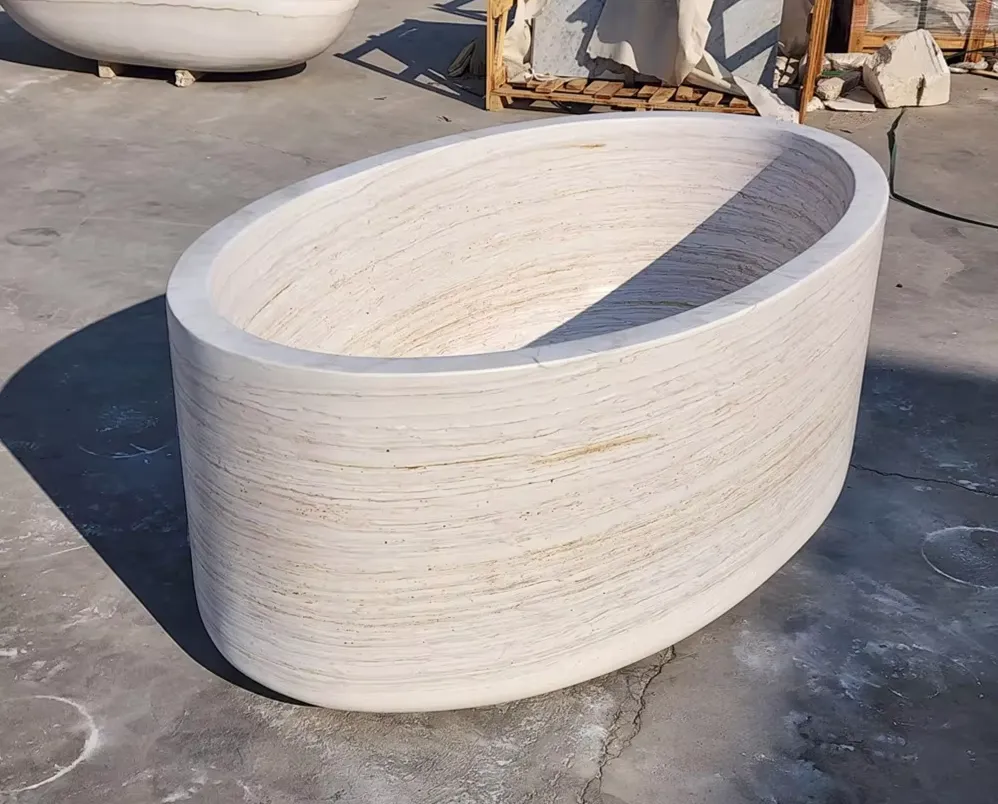
Travertine Table Sustainability: Low-Carbon Origin and Natural Advantages
Natural Formation and Low-Energy Extraction vs. Engineered Stone
Travertine forms naturally through mineral deposition from geothermal springs—no human energy input required. Quarrying relies on diamond wire saws with water cooling, a low-energy mechanical process far less intensive than the resin blending, high-temperature sintering, or kiln firing needed for quartz or porcelain. Unlike engineered alternatives, travertine avoids polyester binders and VOC-emitting curing stages. Minimal finishing—often honed or tumbled via mechanical abrasion—preserves its inherent character while further reducing energy use. This streamlined extraction and processing yields a significantly lower embodied carbon profile: a travertine tabletop slab requires roughly 60% less energy to produce than a comparable quartz slab (Natural Stone Institute, 2023). Its natural porosity also reduces weight per square meter, lowering transportation emissions. By choosing travertine, buyers opt out of petrochemical manufacturing loops and align with circular economy principles—prioritizing nature’s efficiency over industrial complexity.
Carbon Footprint Comparison: Travertine Table vs. Quartz and Porcelain Alternatives
Life-cycle assessment data confirms travertine’s environmental advantage: a travertine tabletop emits approximately 2.3 kg CO₂e per square foot, compared to 5.8 kg for quartz and 4.5 kg for porcelain (Sustainable Materials Database, 2024).
| Material | Embodied Carbon (kg CO₂e/sq ft) | Primary Energy Source |
|---|---|---|
| Travertine Table | 2.3 | Quarrying and light finishing |
| Quartz | 5.8 | Resin curing, high-temp compression |
| Porcelain | 4.5 | Kiln firing at 1,200–1,400°C |
The gap reflects fundamental differences in production: travertine undergoes mechanical transformation only, while quartz depends on petrochemical resins and thermal curing, and porcelain demands extreme thermal energy. Crucially, travertine’s durability extends this advantage—its multi-decade service life spreads its initial carbon investment over decades, reducing annualized impact more effectively than shorter-lived alternatives.
Travertine Table Longevity and End-of-Life Benefits
50+ Year Durability Reduces Replacement Cycles and Resource Demand
Travertine tables routinely exceed 50 years of functional, aesthetic performance. Its natural density and compressive strength resist scratching, thermal shock, and daily wear—without the delamination, fading, or staining common in resin-bound composites. The Colosseum—built from travertine in 80 AD—remains standing as enduring proof of its resilience. A single well-maintained travertine dining or coffee table can eliminate three or more replacements over a century, cutting cumulative resource demand by an estimated 60%. This longevity directly lowers the environmental burden of furniture production, minimizes landfill waste, and supports low-consumption living—not as a trend, but as built-in material intelligence.
Fully Recyclable and Reusable — Unlike VOC-Emitted Composites
At end-of-life, travertine is reclaimed, not discarded. As solid, inert stone, it can be cleanly crushed into aggregate for road bases, concrete fill, or new architectural surfaces—no chemical breakdown or off-gassing required. In contrast, quartz and other resin-based composites often release VOCs during production and disposal, and their synthetic binders prevent true recycling. The Natural Stone Institute confirms natural stone like travertine poses no indoor air quality risk and does not off-gas. Reclaimed travertine qualifies for LEED and BREEAM credits when reused in new construction—supporting cradle-to-cradle design without compromise. Where composites typically end in landfills, travertine closes the loop: durable by design, restorable by nature, and regenerative by practice.
Market Demand for the Travertine Table: Where Sustainability Meets Premium Aesthetics
Consumers and designers increasingly seek furnishings that marry ecological integrity with refined aesthetics—and the travertine table delivers both. Its organic veining, warm tonal variation, and tactile texture complement modern minimalism, Scandinavian simplicity, and rustic elegance alike. More importantly, its low-carbon origin, zero-VOC profile, and full recyclability meet rigorous sustainability benchmarks without sacrificing luxury. This dual value proposition—authentic beauty rooted in responsible materiality—has elevated travertine beyond niche appeal into mainstream residential and commercial projects. As sustainable luxury shifts from aspiration to expectation, the travertine table stands out not just as décor, but as a deliberate, future-proof choice.
Certified Travertine Table Sourcing: Aligning with LEED, BREEAM, and Responsible Quarrying Standards
Case Study: LEED-Platinum Project Using Traceable Travertine Table Installations
In 2023, a Chicago corporate headquarters achieved LEED Platinum certification in part through strategically integrated travertine tables in its lobby and collaborative spaces. The design team selected travertine specifically for its verified low-carbon footprint and timeless presence. Sourced from a quarry within 400 miles, the material qualified for LEED’s regional materials credit. The supplier provided a third-party-verified Environmental Product Declaration (EPD) and full chain-of-custody documentation—confirming adherence to ISO 14040-compliant quarrying practices and responsible water management. These transparent credentials contributed directly to maximum Materials & Resources points, while the tables themselves served as durable, elegant focal points. The project demonstrates how a single, thoughtfully specified travertine table can advance green building goals—proving sustainability and sophistication need not compete, but reinforce each other.
FAQs
What makes travertine tables more sustainable than quartz or porcelain alternatives?
Travertine tables are more sustainable due to their low-energy extraction process, absence of petrochemical resins, and significantly lower carbon footprint compared to quartz or porcelain. Additionally, they are durable and recyclable, reducing lifecycle environmental impact.
How durable are travertine tables?
Travertine tables can last over 50 years due to their natural density and resistance to scratch, thermal shock, and daily wear. Historical landmarks like the Colosseum demonstrate the material’s longevity.
Can travertine tables be recycled?
Yes, travertine tables can be reclaimed and recycled into aggregate for construction purposes or reused in architectural projects, supporting a circular economy.
How does travertine align with green building certifications like LEED?
Travertine qualifies for LEED and BREEAM credits due to its low-carbon footprint, local sourcing, and traceable quarrying practices. It meets strict sustainability standards for environmentally friendly projects.
Table of Contents
- Travertine Table Sustainability: Low-Carbon Origin and Natural Advantages
- Travertine Table Longevity and End-of-Life Benefits
- Market Demand for the Travertine Table: Where Sustainability Meets Premium Aesthetics
- Certified Travertine Table Sourcing: Aligning with LEED, BREEAM, and Responsible Quarrying Standards
- FAQs