 EN
EN

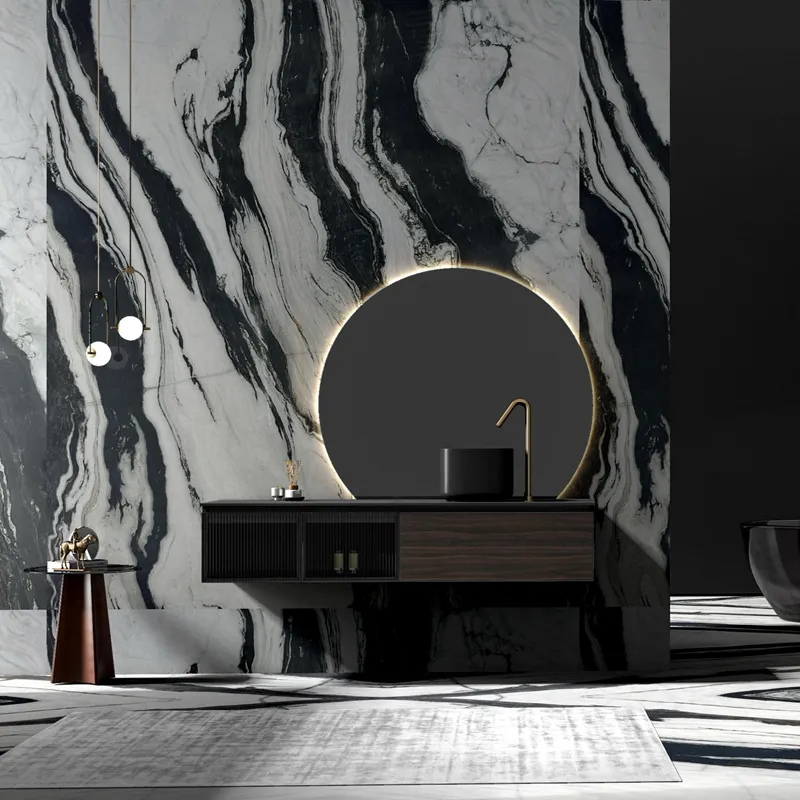
Precision CNC Fabrication for Architectural-Scale Marble Projects
A powerful marble supplier distinguishes itself by executing architectural-scale projects with precision CNC (Computer Numerical Control) fabrication. This capability transforms raw stone into complex structural components that meet exact design specifications—minimizing installation errors, reducing material waste, and enabling designs previously considered impractical in natural stone.
Five-axis bridge cutters and multi-blade gang saws for complex geometries and tight tolerances
Five-axis bridge cutters and multi-blade gang saws form the technical foundation of high-precision architectural stone fabrication. These machines move cutting tools across five axes simultaneously, enabling compound curves, beveled profiles, undercuts, and other intricate geometries unattainable with conventional equipment. Built on rigid frames with high-grade linear guides and servo-driven motion control, they achieve dimensional accuracy within ±1 mm—even for monolithic panels, waffle slabs, or deeply profiled cornices. Regular calibration ensures consistency across production runs. Meanwhile, multi-blade gang saws deliver high-volume slab cutting with exceptional thickness uniformity and surface flatness. For architects and contractors, this precision translates directly to reduced on-site rework, faster installation, and predictable project timelines—key advantages in large-scale commercial and institutional builds.
Integrated 3D modeling, CNC drilling, and curved column fabrication for custom structural elements
Custom structural elements—including curved columns, arches, and integrated sink basins—require a seamless digital-to-physical workflow. Integrated 3D modeling allows designers to export geometry files directly to CNC systems, eliminating manual transcription errors and ensuring fidelity from concept to fabrication. CNC drilling units then bore anchor holes, drainage channels, and service apertures with sub-millimeter positional accuracy—critical for load-bearing assemblies. Curved columns are cut from solid blocks using CNC mono-wire saws programmed with variable trajectories and 3D pathing, producing smooth, continuous curves. Subsequent surface refinement and edge profiling are handled on the same 5-axis platform. This end-to-end digital process delivers fully engineered, installation-ready components—replacing fragmented, labor-intensive workflows with a single-source solution trusted for high-stakes architectural applications.
Vertically Integrated Supply Chain: Control from Quarry to Book-Matched Slab
Owned quarries ensuring material consistency, ethical sourcing, and full traceability for the marble supplier
Vertical integration begins at the quarry face. By owning extraction sites, a marble supplier maintains direct control over block selection—guided by geologists who assess veining continuity, color stability, and structural integrity before extraction. This eliminates the risk of inconsistent or substandard material entering production, a common issue in fragmented supply chains. Ethical sourcing is verified through documented labor practices and environmental compliance, with each block assigned a unique digital or paper trail from quarry to factory. Full traceability enables project teams to audit slab origin within hours—not weeks—and guarantees that the visual and physical characteristics specified during design match what arrives on site. The result is uniformity across large orders and confidence in aesthetic continuity—especially critical for expansive feature walls, lobbies, or façades.
Book-matching systems with dry-lay sorting, sequential numbering, and batch-level slab management
Book-matching leverages the natural symmetry of adjacent slabs cut from the same block to create mirror-image veining patterns. A rigorous dry-lay sorting process lays slabs flat for visual assessment of vein flow and tonal harmony before cutting. Each slab receives a sequential number tied to its position in the original block—establishing an immutable sequence that guides both fabrication and installation. For large projects, batch-level slab management ensures all book-matched pairs within a lot share consistent geological traits: color saturation, grain density, and translucency. This prevents mismatches across expansive surfaces and simplifies replacements—if a slab is damaged, the supplier retrieves the exact batch and sequence, preserving the original design intent. Together, these practices transform marble’s inherent variability into a repeatable, specification-grade product.
Rigorous, Standards-Based Quality Assurance Across the Production Lifecycle
ISO 9001-certified quality control—from extraction and calibration to packaging and logistics
Quality assurance is embedded—not appended—at every stage of production. ISO 9001 certification mandates a documented, auditable system beginning at extraction, where dimensional accuracy is monitored in real time. Saws and CNC routers undergo routine calibration against master templates, and in-process inspections catch deviations before downstream impact. Each slab carries a unique identifier, linking it to its block origin, processing history, and test results. Packaging protocols protect edges and surfaces, while logistics partners are vetted for handling compliance. This closed-loop approach ensures only materials meeting strict tolerance and aesthetic criteria leave the facility—reducing on-site rejects and avoiding costly delays.
ASTM C503/C1527 validation: porosity, flexural strength, density, and petrographic composition testing
Physical performance data validates long-term suitability. Every production batch undergoes testing per ASTM C503 (marble dimension stone) and C1527 (travertine), measuring water absorption (<0.20% indicates low porosity), flexural strength (>7 MPa confirms bending resistance), and density (revealing internal homogeneity). Petrographic analysis identifies mineral composition and flags problematic inclusions—such as pyrite veins or expansive clays—that could lead to spalling or discoloration. These objective metrics give architects engineering confidence to specify marble for structural cladding, exterior façades, or high-traffic flooring—where durability and predictability are non-negotiable.
Advanced Surface Finishing & Value-Added Manufacturing Capabilities
Seven repeatable surface modalities (leathered, flamed, bush-hammered, etc.) with digital finish profiling
Surface finish is not decorative—it’s functional, durable, and specification-critical. A leading marble supplier deploys seven repeatable modalities—leathered, flamed, bush-hammered, honed, polished, sandblasted, and split-face—each calibrated to meet precise performance requirements. For example, a flamed finish reliably achieves a wet dynamic coefficient of friction ≥0.42 (per ASTM C1028), satisfying safety standards for pool decks and public plazas. These finishes are not hand-applied approximations but digitally controlled processes: optical profilometers capture topographic data—measuring peak-to-valley depth in microns—enabling exact replication years later, even for replacement tiles. Quick-change tooling on advanced CNC work centers minimizes downtime between modalities, supporting lean, responsive manufacturing. Delivering this full range in-house eliminates subcontractor coordination, ensures unified aesthetic execution, and compresses project schedules—making marble a viable, predictable choice for demanding architectural specifications.
FAQ
What is CNC fabrication in the context of marble projects?
CNC (Computer Numerical Control) fabrication is a manufacturing process that uses pre-programmed computer software to precisely control machinery. In marble projects, it is used to create intricate structural components with exact dimensions and shapes.
What is the benefit of five-axis bridge cutters for marble projects?
Five-axis bridge cutters enable precise multi-directional cutting to create complex geometries, such as curves and detailed profiles, with minimal errors and high dimensional accuracy.
How does vertical integration improve marble quality?
Vertical integration provides control over the supply chain, from quarrying to final processing, ensuring material consistency, ethical sourcing, and traceability across all production phases.
What is book-matching in marble fabrication?
Book-matching involves aligning adjacent marble slabs to create mirror-image veining patterns, enhancing aesthetic appeal, and ensuring visual continuity in large surfaces.
What quality standards apply to marble fabrication?
Marble fabrication follows strict quality standards, including ISO 9001 certification and ASTM C503/C1527 testing, to ensure material durability, porosity, density, and composition meet professional requirements.