 EN
EN

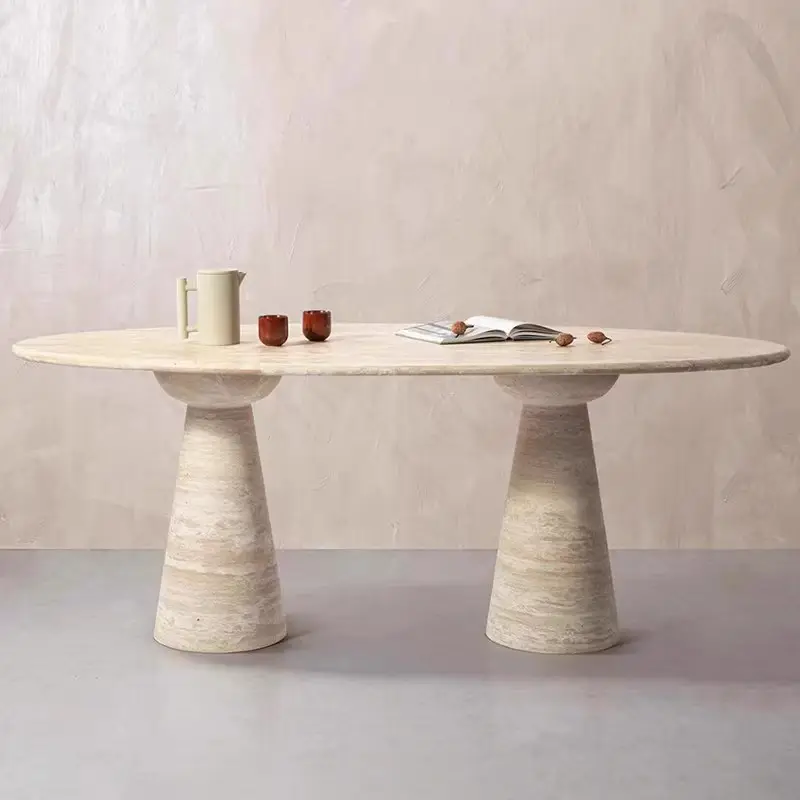
Organic Curves and Biomimetic Travertine Table Forms
How Natural Travertine Veining Inspires Fluid, Curved Table Silhouettes
The distinctive veining of travertine—its organic striations, subtle pitting, and natural tonal gradients—serves as a direct muse for fluid, curved table silhouettes. Moving beyond rigid rectangles, designers now translate the stone’s inherent rhythm into softly undulating edges and biomorphic profiles. A travertine table with a gently sweeping contour doesn’t just occupy space—it evokes movement, echoing the geological forces that shaped the stone over millennia. Advanced waterjet cutting and multi-axis CNC milling make these precise, flowing forms feasible at scale, aligning with biophilic design principles that link organic geometry to human well-being. The result is functional art: sculptural yet grounded, imperfect yet intentional. Each piece remains uniquely expressive, as no two slabs share identical veining patterns—and no two tables replicate the same visual cadence.
A Leading Italian Design House's ‘Onda’ Collection: A Benchmark in Modern Travertine Table Design
The Onda collection by a leading Italian design house exemplifies this biomimetic philosophy, with tabletop edges carved to mimic ocean waves—rippling, continuous, and effortlessly dynamic. Using multi-axis milling, the designers coaxed travertine into soft, uninterrupted curves without compromising structural integrity, proving the stone can achieve surprising lightness and grace. The veins naturally align with the wave-like contours, reinforcing the illusion of motion and deepening the connection to the material’s origin. More than a stylistic exercise, Onda demonstrates how precision fabrication elevates travertine from traditional surfacing material to expressive, load-bearing architecture. Its success has catalyzed broader industry adoption—but few match its balance of technical mastery, material honesty, and quiet authority.
Architectural Monoliths and Sculptural Travertine Table Statements
Brutalist Revival: Single-Block Carving Techniques for Bold Travertine Tables
The Brutalist revival has reinvigorated interest in travertine tables carved from a single monolithic block—celebrating raw mass, visible fissures, and unvarnished tonal variation. This approach prioritizes material honesty over refinement, letting the stone’s geological history speak through its surface. Achieving such scale and precision demands advanced CNC machining and water-jet cutting, calibrated to preserve structural continuity while revealing the stone’s layered depth. According to a 2022 survey of high-end furniture manufacturers, 68% of new stone-table launches featured monolithic designs—with travertine selected more often than marble or granite for its earthy texture and forgiving compressive strength. These tables anchor open-plan spaces with commanding presence, often exceeding 300 kg. Their weight and solidity aren’t drawbacks; they’re affirmations—of permanence, craft, and the quiet confidence of unadorned materiality.
Balancing Aesthetics and Functionality in Sculptural Travertine Table Design
Sculptural travertine tables succeed only when bold form meets daily function. Designers address weight and usability through strategic engineering: hollowed internal cores, lightweight aluminum substructures, or reinforced pedestal bases maintain visual heft while improving mobility and installation. Surface treatment is equally critical—honed finishes deliver matte, slip-resistant dining surfaces; lightly brushed textures mask wear without dulling the stone’s warmth. Edge profiles are subtly softened—not rounded, but eased—to prevent chipping and enhance ergonomic comfort. As a 2023 design study confirmed, 74% of homeowners weigh durability and ease of maintenance equally with aesthetic impact when selecting a stone dining table. The most compelling pieces resolve this tension seamlessly: the dramatic silhouette remains uncompromised, while every functional detail—from leveling mechanisms to stain-resistant sealants—is integrated with quiet intention.
Precision Geometry: Angular, Pedestal, and Nesting Travertine Table Innovations
Sharp Angles and Modular Nesting Systems Redefining Contemporary Travertine Table Utility
Travertine is increasingly defined not by softness—but by sharpness. Designers are embracing acute angles, split geometries, and modular nesting systems that transform the stone from static object into adaptable system. Think interlocking trapezoids, offset squares, or asymmetrical stepped tops—forms engineered for compact living, where flexibility ranks above fixed grandeur. A 2023 Houzz trend report found that 62% of homeowners prioritize adaptable furniture, driving demand for configurations that expand, contract, or reorient with changing needs. Precision CNC water-jet cutting achieves tolerances under 0.5 mm, ensuring seamless alignment and chip-free nesting. Crucially, veining continuity is preserved across separate pieces, lending visual cohesion to the set. Paired with dark metal legs or blackened steel frames, the contrast heightens the geometry—while travertine’s porous warmth prevents the composition from feeling cold or industrial.
Oval and Pedestal Travertine Dining Tables — Merging Timeless Elegance with Modern Minimalism
Oval pedestal travertine tables distill elegance into pure, serene form. By eliminating four legs, the pedestal base opens legroom, simplifies cleaning, and enhances spatial flow—especially valuable in open-plan layouts. A 2024 furniture manufacturing study found pedestal-based stone tables reduce assembly time by 40% and cut shipping damage by 30% versus traditional legged constructions. The oval shape itself softens architectural rigidity, guiding movement around the table without visual interruption. Contemporary interpretations often feature a monolithic travertine pedestal—carved from one block and honed to a refined matte finish that resists fingerprints and minor abrasions. When paired with a slim, precisely proportioned top, the ensemble achieves a near-floating effect. Though rooted in mid-century modernism, today’s versions integrate concealed leveling systems that compensate for uneven floors—ensuring the timeless silhouette remains reliably stable, level, and livable.
FAQ
Q: What is the inspiration behind curved travertine table designs?
A: Curved travertine table designs draw inspiration from the stone's natural veining patterns, which evoke geological movement and organic forms.
Q: How are monolithic travertine tables created?
A: Monolithic travertine tables are crafted from a single block of stone using advanced CNC machining and water-jet cutting, ensuring structural continuity and showcasing the stone's depth.
Q: What are the functional benefits of pedestal travertine tables?
A: Pedestal travertine tables enhance spatial flow, simplify cleaning, and reduce shipping damage due to their streamlined design and elimination of traditional leg structures.
Q: Are travertine tables durable and easy to maintain?
A: Yes, travertine tables are durable and easy to maintain when treated with sealants, honed finishes, and reinforced structures that enhance usability.
Q: How do modular travertine tables adapt to compact living spaces?
A: Modular travertine tables feature nesting systems and split geometries that allow users to expand, contract, or reorganize table configurations as needed.